
KHJ at EMAX 2023: Release Tapes for Southeast Asia’s Back-End Packaging Hub
2026-09-16 By KHJ
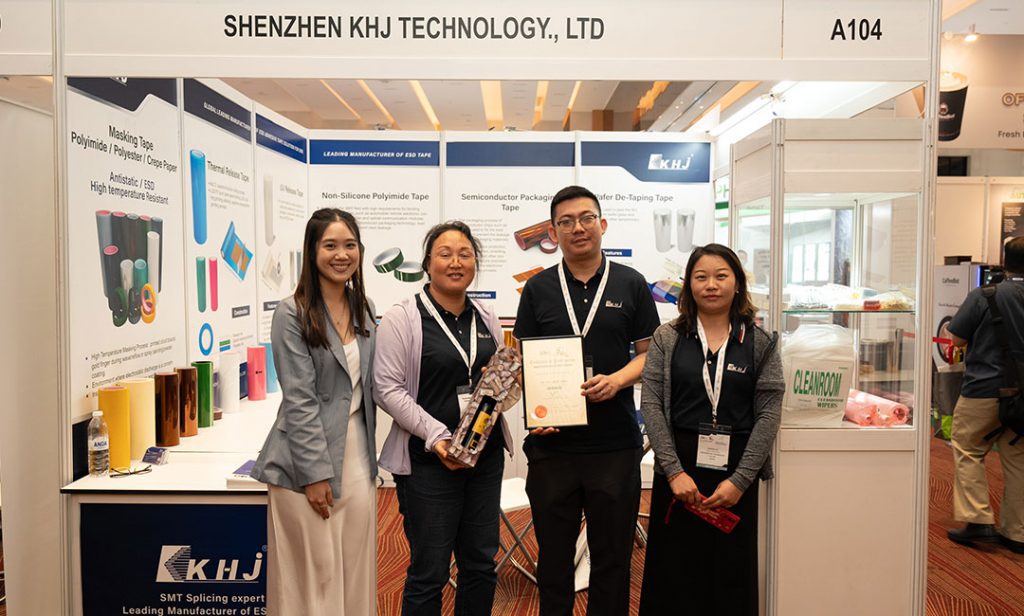
Shenzhen KHJ Technology Co., Ltd. (KHJ) exhibited at EMAX 2023 — the Electronics Manufacturing Expo Asia, held 12–14 July 2023 at the Setia SPICE Convention Centre in Penang, Malaysia. The show ran alongside the Penang Manufacturing Expo (PMAX) and featured more than 200 international exhibitors and over 8,000 trade visitors, with technical sessions organised by bodies including SMTA and the Federation of Malaysian Manufacturers.
Penang carries the nickname “Silicon Valley of the East” for a reason. The island and the Bayan Lepas industrial park hold one of the largest concentrations of back-end semiconductor assembly, test and packaging operations anywhere, alongside a dense network of EMS and precision engineering suppliers. For a tape maker whose release products sit inside the dicing and grinding steps, that is the right room to be in.
| Event | EMAX 2023 — Electronics Manufacturing Expo Asia (with PMAX) |
|---|---|
| Dates | 12–14 July 2023 |
| Venue | Setia SPICE Convention Centre, Penang, Malaysia |
| Organiser | NRG Exhibitions (M) Sdn Bhd |
| Exhibitor | Shenzhen KHJ Technology Co., Ltd. |
| Booth | [Hall + booth number] |
| Products on display | UV release tape, thermal release tape, SMT splice tape, crepe paper masking tape |
UV release tape — built around the dicing step
UV release tape drew the most technical scrutiny, which is not surprising in a room full of packaging engineers. The tape holds high tack through dicing, grinding and die expansion, then falls to a low-tack state after a short UV exposure, so thin and fragile dies come off with far less stress. Chipping and cracking almost always trace back to the de-taping step, and that is the failure this product is designed to remove.
Antistatic grades are available for static-controlled lines, with surface resistivity in the 106–109 Ω/sq range in line with IEC 61340-5-1.
Typical uses: wafer dicing and die expansion, BGA and QFN packaging, semiconductor back-grinding, temporary protection of polished and coated surfaces.
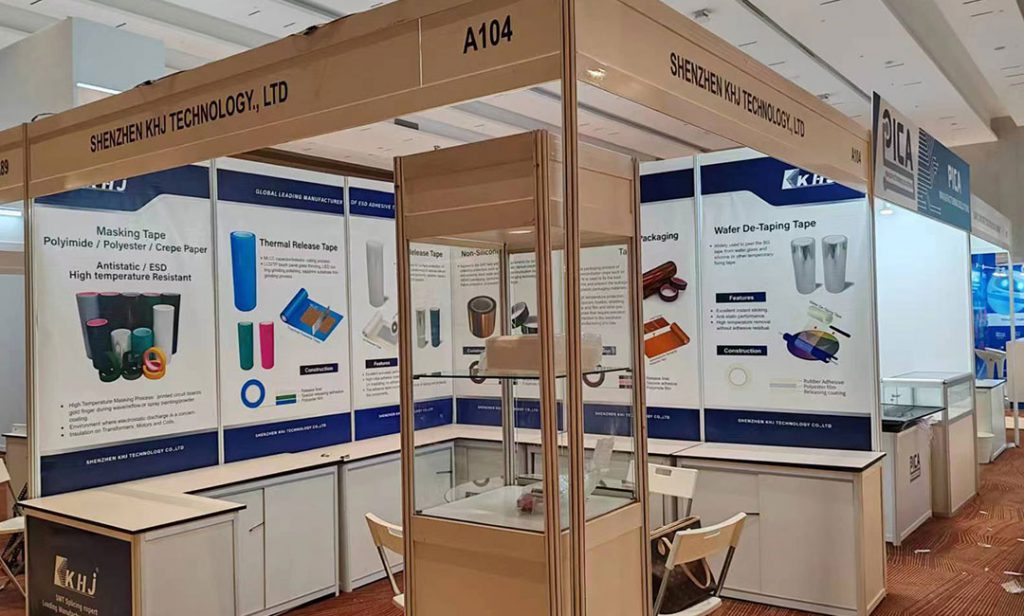
Thermal release tape — the heat-triggered alternative
Where a thermal step already exists in the process, or where UV cannot reach every part of the assembly, thermal release tape does the same job on a different trigger. Adhesion is stable at room temperature and collapses once the tape passes its release temperature [insert °C range for the grade]. It is used for wafer back-grinding and thinning, QFN lead-frame singulation, and temporary mounting of glass, ceramic and metal parts, and it leaves nothing behind that shows up under normal inspection.
Typical uses: wafer back-grinding and thinning, QFN/BGA singulation, glass and ceramic substrate processing, temporary fixing in precision machining.
SMT splice tape and crepe paper masking tape
Penang’s assembly side is as busy as its packaging side, so we brought SMT splice tape as well. It joins two carrier tape ends so a reel change costs no machine stoppage, holds registration through the feeder, and stays bonded under the heat and vibration of placement. Standard widths from 8 mm to 44 mm are covered [confirm range against your product sheet], with antistatic options for ESD-controlled lines.
Our crepe paper masking tape rounds out the range for the everyday work: masking boards through wave soldering and conformal coating, protecting parts during spray finishing, insulating coils and transformers. It tears by hand, follows edges, holds at temperature [insert temperature rating], and peels in one piece without transferring adhesive.
Two shows in two months — why Southeast Asia
EMAX followed our NEPCON Thailand exhibition in June by a few weeks, and that was deliberate. The electronics supply chain in this region is being rebuilt in real time, with packaging, test and assembly capacity moving into Malaysia, Thailand and Vietnam. Suppliers who only read about it and suppliers who show up are not in the same position.
What we heard in Penang was consistent with what we heard in Bangkok: buyers want local availability without giving up consistency. A roll that behaves differently between batches costs a packaging line far more than the tape is worth, so the question is never only about the datasheet. It is about whether the next shipment matches the last one, and whether someone answers the phone when a line goes down.
Talk to us
Send us your process details — substrate and thickness, dicing or grinding conditions, UV dose or release temperature, tape width — and we will match a grade and dispatch samples for evaluation.
Shenzhen KHJ Technology Co., Ltd.
Email: sales@khj.cn
Website: www.khjtech.com
TRENDING POSTS
- * KHJ Showcases Advanced Adhesive Tape Solutions at SEMICON West 2026 in San Francisco
- * KHJ at FILM & TAPE EXPO 2025: The Hall Stayed the Same, the Buyers Didn’t
- * KHJ at SEMICON West 2025: The Show Moved to Where the Fabs Are
- * KHJ Returns to NEPCON Vietnam 2025: What Two Years Changed
- * KHJ Returns to EMAX 2025 Penang: A Bigger Show Than We Left
HOT TOPIC
-
772
Acrylic Foam Tape
conductive cloth die cutting
Die-Cut
die cutting tape
Double Sided Foam Tape
EMI shielding gasket
foam die cutting
Foam Tape
graphite die cutting
heat restrant tape
heat sink die cutting
high temperature tape
kapton tape
khj
Labels
LCD buffer pad
LCD shielding
L foam
Non-silicone Polyimide Tape
PCB
PI tape
polyimide tape
polyimide tape,kapton tape
precision die cutting
Reflow soldering masking
SEMICON West
senmiconductor
tape
thermal management
thermal release tape
UV Release Tape
wafer
Wafer cutting