
KHJ at NEPCON Thailand 2024: Tape Solutions for Southeast Asia’s Assembly Lines
2026-09-23 By KHJ
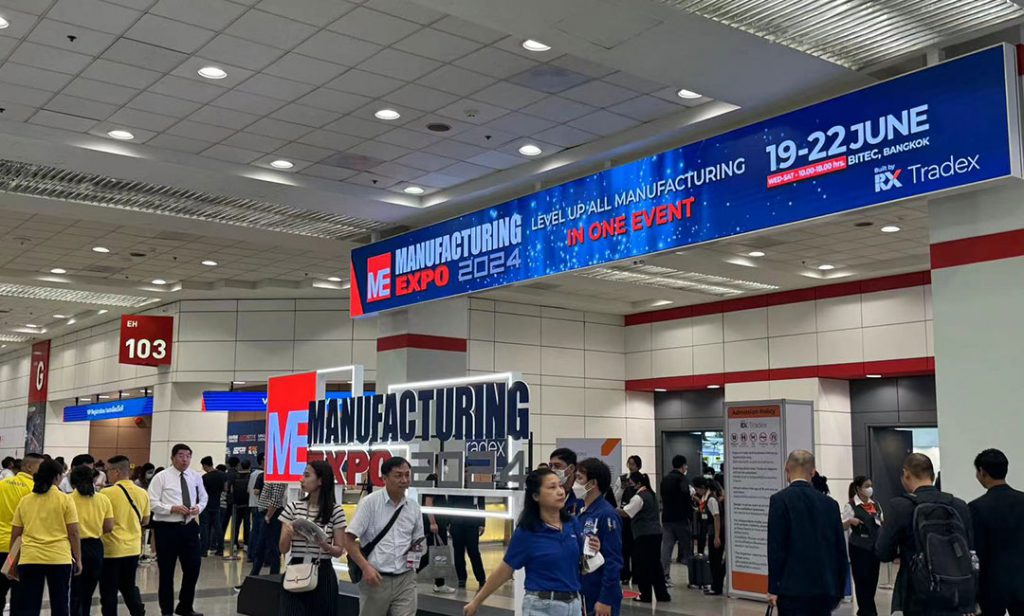
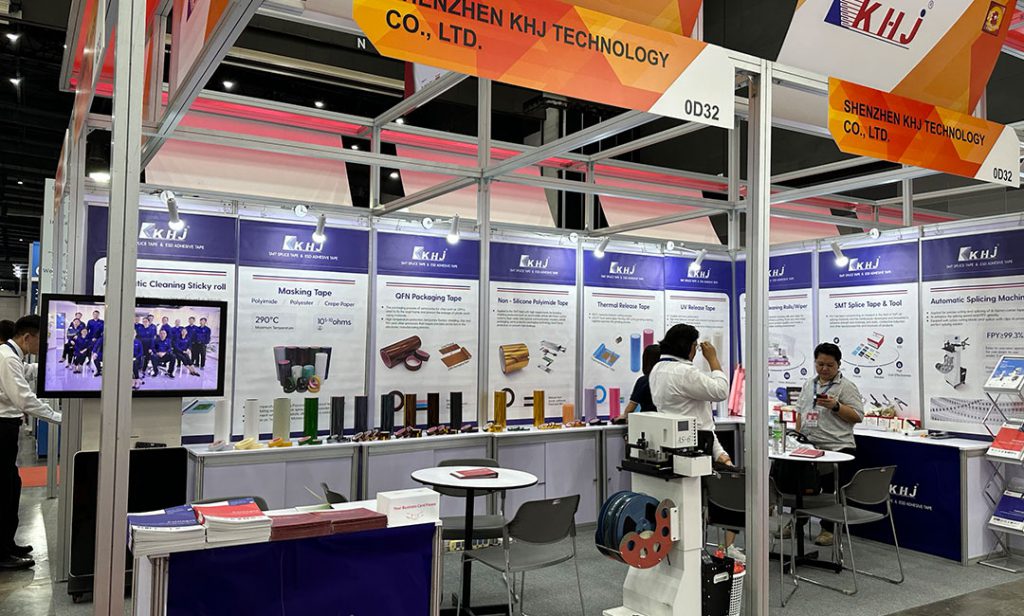
Shenzhen KHJ Technology Co., Ltd. (KHJ) exhibited at NEPCON Thailand 2024, held 21–24 June 2024 at BITEC, the Bangkok International Trade & Exhibition Centre. As ASEAN’s leading exhibition for assembly, measurement and testing technology in electronics manufacturing, the show gathered more than 420 brands and over 10,000 trade visitors from across ASEAN under the theme “Riding the Digital Wave”.
Thailand is not a market you visit for the sake of a stamp in the passport. It is where a large share of the region’s automotive electronics, HDD, PCB and appliance production actually sits, and where a growing number of Chinese and Taiwanese manufacturers are building second bases. We went to meet the people running those lines.
| Event | NEPCON Thailand 2024 |
|---|---|
| Dates | June 19th – 22nd 2024 |
| Venue | BITEC — Bangkok International Trade & Exhibition Centre, Bangkok, Thailand |
| Organiser | RX Tradex |
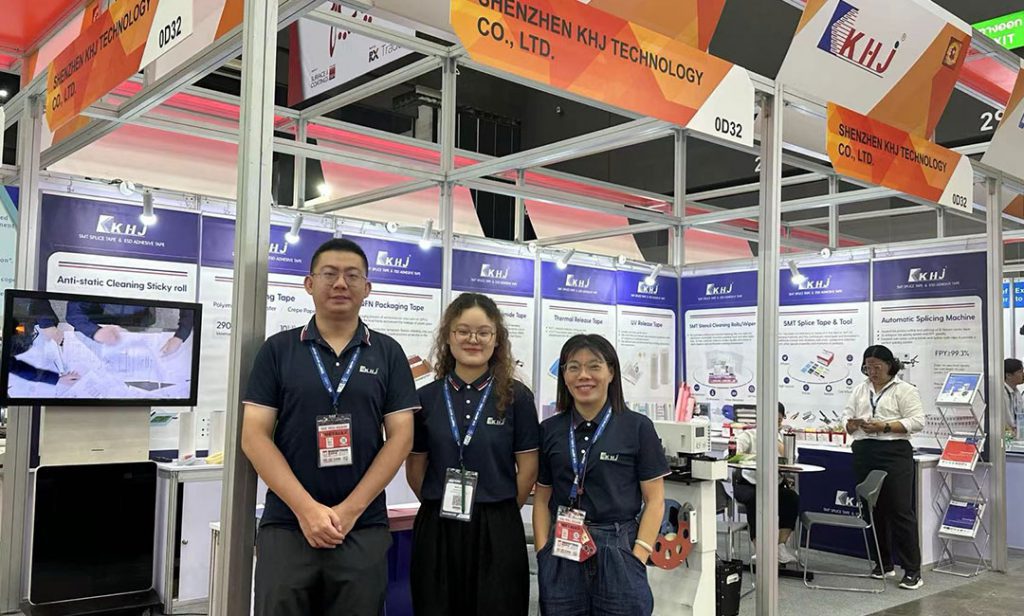
| Exhibitor | Shenzhen KHJ Technology Co., Ltd. |
| Booth | [Hall + booth number] |
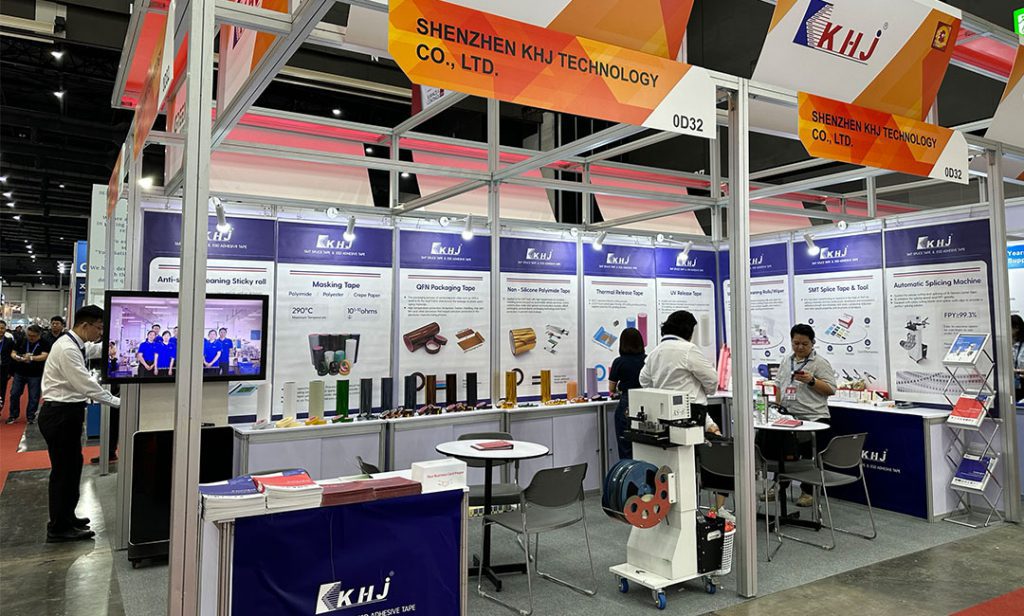
| Products on display | SMT splice tape, UV release tape, thermal release tape, crepe paper masking tape |
SMT splice tape — the product that pays for itself
On a show floor built around placement machines, SMT splice tape was our most handled sample. The pitch is short because the maths is short: every reel change stopped for a feeder reload is a machine idle, and splicing the carrier tape instead removes that stoppage entirely. Our tape holds registration through the feeder, survives the heat and vibration of placement, and is available for standard carrier tape widths from 8 mm to 44 mm [confirm range against your product sheet], with antistatic grades for ESD-controlled lines.
Most of the visitors at the booth ran lines in automotive, HDD and consumer electronics, where uptime is measured against daily output targets. That is the only argument this product needs.
Typical uses: SMT feeder reel changeover, carrier tape joining and repair, high-mix and small-batch placement.
UV release tape and thermal release tape — for the packaging side
Thailand and the surrounding region host a substantial back-end packaging and test industry, so we brought both release technologies.
UV release tape holds high tack through dicing, grinding and die expansion, then drops to a low-tack state after a short UV exposure, letting thin and fragile dies be picked up with less stress — which is where chipping and cracking start. Antistatic grades are available with surface resistivity in the 106–109 Ω/sq range in line with IEC 61340-5-1.
Thermal release tape does the same job on a heat trigger: stable adhesion at room temperature, collapsing once the tape passes its release temperature [insert °C range for the grade]. It suits wafer back-grinding, QFN singulation and temporary mounting of glass, ceramic and metal parts, and leaves nothing behind that shows up under normal inspection.
Typical uses: wafer dicing and die expansion, BGA and QFN packaging, back-grinding and thinning, glass and ceramic substrate processing.
Crepe paper masking tape — everyday work on the line
The crepe paper masking tape range drew steady interest from PCB and assembly visitors for the jobs that never make it into a product brochure: masking boards through wave soldering and conformal coating, protecting housings during spray finishing, insulating coils and transformers, bundling and holding on the bench. The crepe backing tears by hand and follows edges and curves, holds at temperature [insert temperature rating], and comes off in one piece without transferring adhesive.
Typical uses: PCB wave-solder and conformal-coating masking, spray painting and surface finishing, coil and transformer insulation, general holding and bundling.
What Bangkok told us
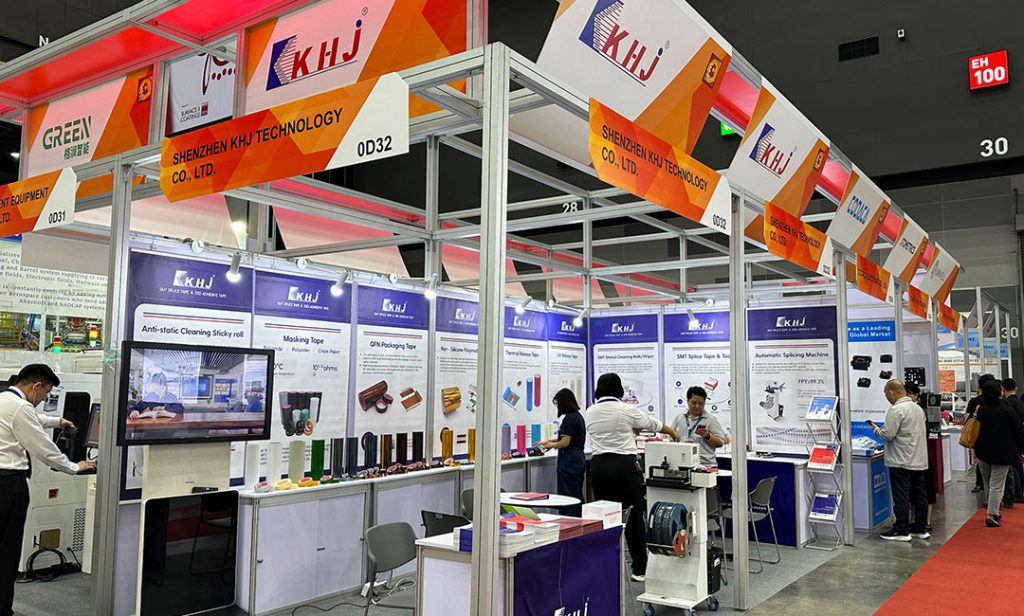
Southeast Asia is no longer only about cost. Buyers we spoke to are qualifying materials against reliability requirements from automotive and medical customers, and they expect the documentation to go with the roll — not just a datasheet, but traceability and consistency from batch to batch. Several conversations were also about supply distance: a Shenzhen factory that can quote, convert and ship quickly is a real advantage against a distant supplier with a twelve-week lead time.
The other recurring question was language and service. Being able to talk to an engineer in English, get drawings marked up and samples dispatched without a week of email tennis, turned out to matter more to some visitors than the product itself.
TRENDING POSTS
- * KHJ Showcases Advanced Adhesive Tape Solutions at SEMICON West 2026 in San Francisco
- * KHJ at FILM & TAPE EXPO 2025: The Hall Stayed the Same, the Buyers Didn’t
- * KHJ at SEMICON West 2025: The Show Moved to Where the Fabs Are
- * KHJ Returns to NEPCON Vietnam 2025: What Two Years Changed
- * KHJ Returns to EMAX 2025 Penang: A Bigger Show Than We Left
HOT TOPIC
-
772
Acrylic Foam Tape
conductive cloth die cutting
Die-Cut
die cutting tape
Double Sided Foam Tape
EMI shielding gasket
foam die cutting
Foam Tape
graphite die cutting
heat restrant tape
heat sink die cutting
high temperature tape
kapton tape
khj
Labels
LCD buffer pad
LCD shielding
L foam
Non-silicone Polyimide Tape
PCB
PI tape
polyimide tape
polyimide tape,kapton tape
precision die cutting
Reflow soldering masking
SEMICON West
senmiconductor
tape
thermal management
thermal release tape
UV Release Tape
wafer
Wafer cutting