
Polyimide Tape in QFN Semiconductor Packaging: An Application Case from the Production Floor
2026-10-20 By KHJ
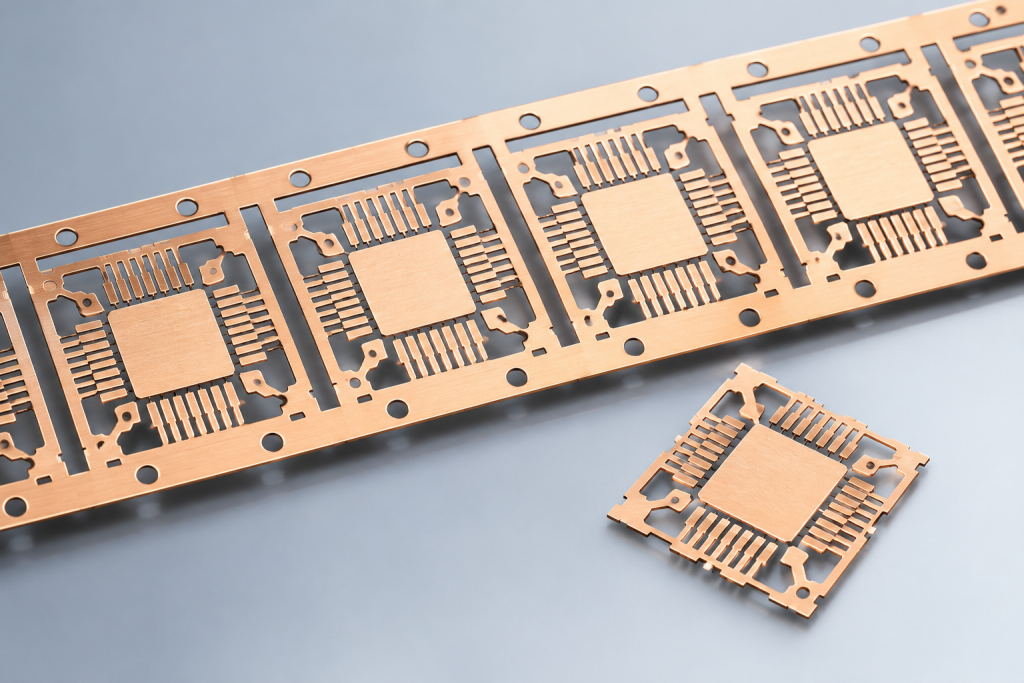
How high-temperature adhesive tape supports leadframe protection, process stability, and clean removal in QFN manufacturing
When a Small Component Creates a Big Manufacturing Challenge
QFN (Quad Flat No-Lead) packages are widely used in power management ICs, automotive electronics, wireless communication devices, and other applications where compact size and efficient thermal performance matter.
Unlike traditional leaded packages, QFN devices use exposed metal pads on the underside of the package for electrical and thermal connections. Their compact structure makes them attractive to semiconductor manufacturers, but it also places tighter demands on material selection and process control.
During leadframe-based QFN production, temporary adhesive materials may be used to protect selected surfaces, support handling, or prevent unwanted contamination at specific manufacturing stages.
The challenge is straightforward: the tape must stay in place when needed, withstand the relevant processing conditions, and come off without damaging the leadframe or leaving adhesive contamination behind.
For one typical QFN leadframe protection application, KHJ evaluated the use of polyimide adhesive tape as a temporary masking and protection material.
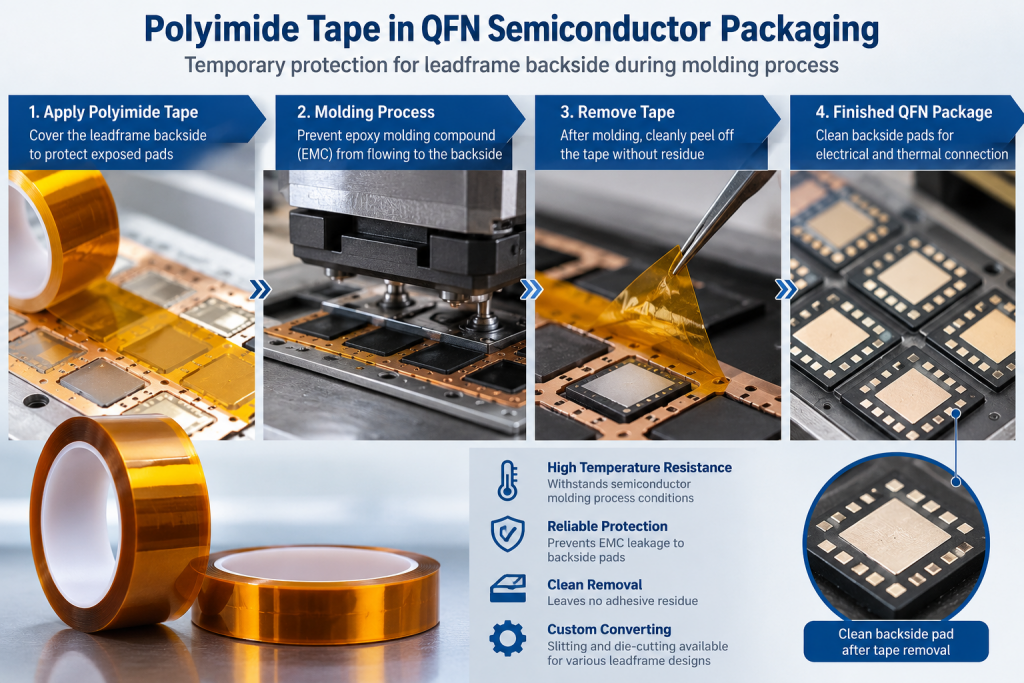
1. The Application: Temporary Protection During QFN Leadframe Processing
QFN packaging involves several manufacturing steps, including leadframe preparation, die attachment, wire bonding or other interconnection processes, molding, singulation, and final inspection.
Depending on the package design and manufacturing equipment, temporary adhesive tape can be introduced at selected stages of this process.
In the application considered here, the requirement was to protect designated leadframe areas during processing while maintaining stable adhesion and allowing controlled removal afterward.
Three material-related concerns needed particular attention.
Adhesive stability under heat
Some processing steps expose the leadframe and its temporary protection materials to elevated temperatures. A conventional adhesive tape may soften, shift, or leave unwanted deposits if it is used outside its intended operating range.
Clean removal from metal surfaces
Adhesive residue on copper or plated leadframe surfaces can interfere with subsequent manufacturing operations. Even small amounts of contamination may require additional cleaning or investigation.
Dimensional consistency
QFN leadframes contain closely spaced features. Protective tape must be accurately positioned, with consistent width, thickness, and edge quality. Poorly controlled tape dimensions can complicate automated handling and alignment.
These requirements made polyimide tape a material worth evaluating.
2. Why Polyimide Tape Was Considered
Polyimide film has a long history of use in electronics manufacturing because of its thermal stability, electrical insulation properties, and dimensional performance.
When combined with a suitable pressure-sensitive adhesive, polyimide tape can serve as a temporary protective material in semiconductor packaging operations.
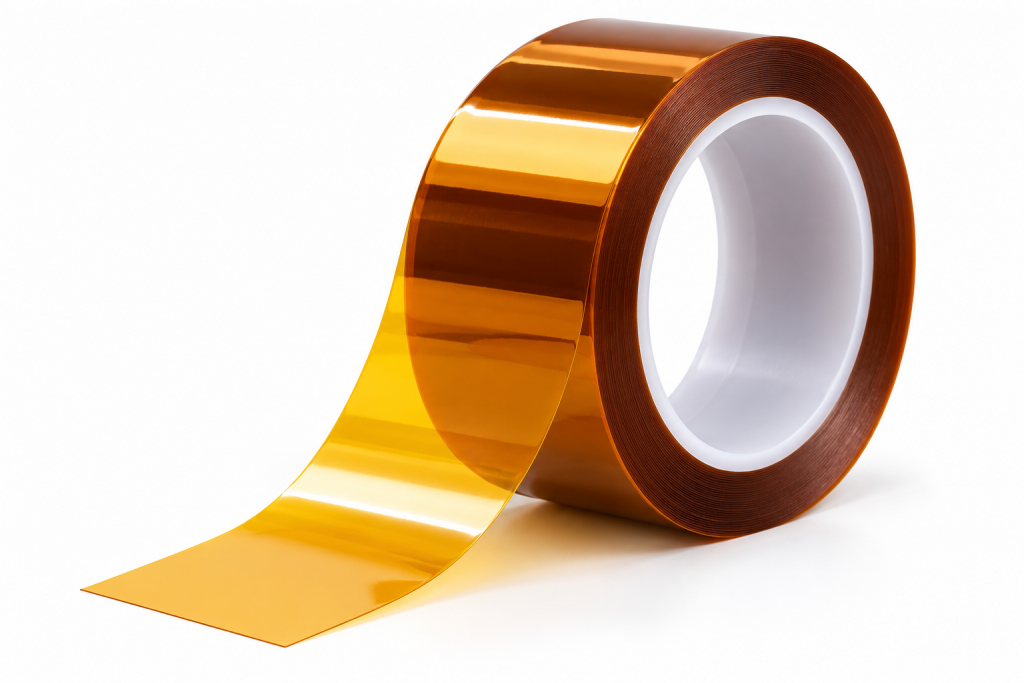
For QFN leadframe processing, the main considerations were:
Thermal Stability
Polyimide film maintains useful mechanical properties at temperatures that would be unsuitable for many general-purpose plastic films.
However, the temperature resistance of the complete tape depends on more than the backing material. The adhesive formulation, exposure duration, surface condition, and process atmosphere must also be considered.
A tape that performs well during short-term heating may behave differently after a prolonged thermal cycle.
Controlled Adhesion and Removal
A temporary protection tape needs enough adhesion to remain attached during handling and processing.
At the same time, excessive adhesion can create problems during removal, particularly on thin or delicate leadframe structures.
The objective is not simply to achieve the highest possible peel strength. It is to establish an appropriate adhesion window for the actual process.
Precision Converting
QFN applications may require narrow tape widths, defined roll dimensions, or custom die-cut shapes.
Consistent slitting and die-cutting are important because uneven edges, loose particles, or dimensional variation can affect material handling and placement accuracy.
For this reason, tape converting quality should be evaluated alongside the adhesive performance.
3. KHJ’s Material Selection Approach
For this type of QFN application, KHJ’s engineering approach begins with the customer’s process conditions rather than selecting a tape based only on its nominal temperature rating.
The following information is particularly useful during material selection:
- Leadframe material and surface finish
- Maximum process temperature and exposure time
- Tape application and removal stages
- Required adhesion and peel behavior
- Tape width, thickness, and converting tolerances
- Cleanliness and contamination requirements
- Compatibility with automated handling equipment
Based on these conditions, different polyimide tape constructions can be considered.
Silicone-based adhesive systems are often evaluated where elevated-temperature performance is important. Acrylic-based systems may be considered where silicone-related contamination is a concern, provided the selected formulation meets the thermal and adhesion requirements.
For sensitive semiconductor applications, silicone-free alternatives may also deserve consideration.
There is no single adhesive system that is suitable for every QFN process. The choice must be confirmed through application-specific testing.
4. Application Evaluation: What Matters on the Production Line
The practical evaluation of a QFN protection tape should focus on how it behaves before, during, and after the intended manufacturing step.
Stage 1: Tape Application
The tape is applied to the designated leadframe area under controlled conditions.
At this stage, engineers check placement accuracy, initial adhesion, wrinkles, trapped air, and possible interference with nearby leadframe features.
Stage 2: Thermal Exposure
The taped leadframe is exposed to a representative process temperature profile.
The evaluation looks for edge lifting, adhesive movement, film distortion, and other visible changes.
Actual production conditions should be reproduced as closely as possible, including dwell time and heating or cooling cycles.
Stage 3: Tape Removal
After the required processing step, the tape is removed using a defined peel angle and speed.
Engineers inspect the leadframe for adhesive transfer, visible contamination, surface damage, or deformation.
For applications with strict cleanliness requirements, visual inspection alone may not be sufficient. Additional surface analysis may be needed.
Stage 4: Process Compatibility
The final assessment considers whether the tape can be consistently applied, processed, and removed using the customer’s existing equipment.
A material may pass a laboratory temperature test but still be unsuitable for high-volume production if it causes feeding problems, inconsistent peeling, or excessive operator intervention.
This is why production trials are an essential part of tape qualification.
5. Engineering Lessons from QFN Tape Selection
Several practical lessons emerge from this type of application.
First, high-temperature resistance does not automatically mean residue-free removal. The polyimide backing and the adhesive must be evaluated as a complete construction.
Second, adhesion should be measured on the actual leadframe surface. Results obtained on stainless steel or other standard test panels do not necessarily predict performance on copper, silver-plated, or other treated surfaces.
Third, the removal conditions matter. Peel angle, speed, and temperature can influence adhesive transfer and the mechanical stress placed on the leadframe.
Finally, precision converting is not a secondary consideration. In tightly controlled semiconductor processes, dimensional consistency and clean tape edges can be just as important as the material’s thermal properties.
The most suitable tape is therefore the one that performs reliably across the complete application and removal sequence, not necessarily the one with the highest published temperature rating.
6. How KHJ Supports QFN Packaging Applications
KHJ manufactures industrial adhesive tapes and provides converting services for electronics and semiconductor manufacturing applications.
For customers developing or optimizing QFN leadframe protection processes, KHJ can support material selection and customized tape formats based on the required manufacturing conditions.
Available development considerations include:
- Polyimide film and adhesive construction selection
- Silicone and suitable acrylic adhesive options
- Customized tape widths and roll dimensions
- Precision slitting and die-cutting
- Sample preparation for process evaluation
- Technical discussion of adhesion, thermal exposure, and removal requirements
Where required, customers can also discuss cleanliness, electrostatic control, and other application-specific requirements before selecting a product.
These characteristics should be confirmed against the technical data and qualification results of the specific tape grade.
7. Conclusion: The Right Tape Is Defined by the Process
In QFN semiconductor packaging, temporary adhesive materials are rarely the most visible part of the production process. Nevertheless, their performance can influence handling efficiency, surface cleanliness, and process consistency.
Polyimide adhesive tape offers a useful combination of thermal stability, thin-film construction, and converting flexibility for selected QFN leadframe protection applications.
Successful implementation depends on matching the complete tape construction to the leadframe surface, processing conditions, and removal requirements.
For semiconductor manufacturers evaluating protective tape for QFN packaging, early material testing can help identify compatibility issues before the material enters volume production.
Looking for Polyimide Tape for QFN Packaging?
KHJ works with semiconductor packaging manufacturers and electronics production teams to develop application-specific adhesive tape solutions.
Contact our team to discuss your leadframe material, temperature profile, tape dimensions, and cleanliness requirements.
Website: https://www.khjtech.com
Request Samples | Custom Sizes | Technical Support
SEO Tags
Polyimide Tape, QFN Packaging Tape, QFN Semiconductor Packaging, Semiconductor Packaging Tape, QFN Leadframe Protection, High Temperature Polyimide Tape, Leadframe Masking Tape, Semiconductor Adhesive Tape, Precision Die Cut Tape, Clean Removal Tape, Silicone Free Polyimide Tape, Semiconductor Manufacturing Materials
Hashtags
#PolyimideTape #QFNPackaging #SemiconductorPackaging #LeadframeProtection #HighTemperatureTape #SemiconductorManufacturing #AdhesiveTape #PrecisionDieCutting #KHJTechnology
TRENDING POSTS
- * Foam Tape in Smartphone Manufacturing: An Application Case for Bonding, Cushioning, and Sealing
- * SMT Splice Tape in PCB Assembly: A Practical Case for Continuous Component Feeding
- * UV Dicing Tape in Semiconductor Wafer Cutting: Reliable Wafer Holding and Clean Die Release
- * Thermal Release Tape for Sapphire Wafer Dicing: Secure Holding, Controlled Release and Cleaner Processing
- * High Temperature Tape for PCB Reflow Soldering: Protecting Critical Areas During SMT Assembly
HOT TOPIC
-
772
Acrylic Foam Tape
conductive cloth die cutting
Die-Cut
die cutting tape
Double Sided Foam Tape
EMI shielding gasket
foam die cutting
Foam Tape
graphite die cutting
heat restrant tape
heat sink die cutting
high temperature tape
kapton tape
khj
Labels
LCD buffer pad
LCD shielding
L foam
Non-silicone Polyimide Tape
PCB
PI tape
polyimide tape
polyimide tape,kapton tape
precision die cutting
Reflow soldering masking
SEMICON West
senmiconductor
tape
thermal management
thermal release tape
UV Release Tape
wafer
Wafer cutting