
High Temperature Tape for PCB Reflow Soldering: Protecting Critical Areas During SMT Assembly
2026-10-21 By KHJ
In PCB assembly, a successful reflow soldering process is not simply about forming reliable solder joints. It is also about protecting the areas of the board that should remain untouched by solder, flux residues, or unnecessary thermal exposure.
For electronics manufacturers handling complex PCB designs, even a small amount of solder contamination in the wrong location can lead to additional cleaning, rework, or product rejection.
This is where high temperature masking tape becomes an important part of the SMT manufacturing process.
Polyimide-based high temperature tapes are widely used for temporary masking and protection during PCB assembly. Their combination of heat resistance, dimensional stability, and controlled adhesion makes them suitable for applications where ordinary adhesive tapes cannot withstand reflow soldering conditions.
1. Application Background: A PCB Assembly Protection Challenge
Consider a typical SMT production line assembling multilayer PCBs with fine-pitch components, exposed gold-plated contacts, and designated areas that must remain free from solder contamination.
During production, certain PCB surfaces require temporary protection. These may include gold fingers, selected contact pads, connector interfaces, or other areas specified in the assembly process.
The production team faces several practical challenges:
- The masking material must tolerate the reflow temperature profile without lifting, shrinking, or leaving excessive adhesive residue.
- It must maintain sufficient adhesion during board handling and conveyor movement.
- The protected surface must remain clean after tape removal.
- Operators need to apply and remove the tape efficiently without damaging the PCB surface.
Conventional packaging tapes or general-purpose masking materials are not designed for this environment. Under elevated temperatures, their backings may deform and their adhesives may soften, transfer, or become difficult to remove.
For this type of application, a properly selected polyimide high temperature tape offers a more suitable solution.
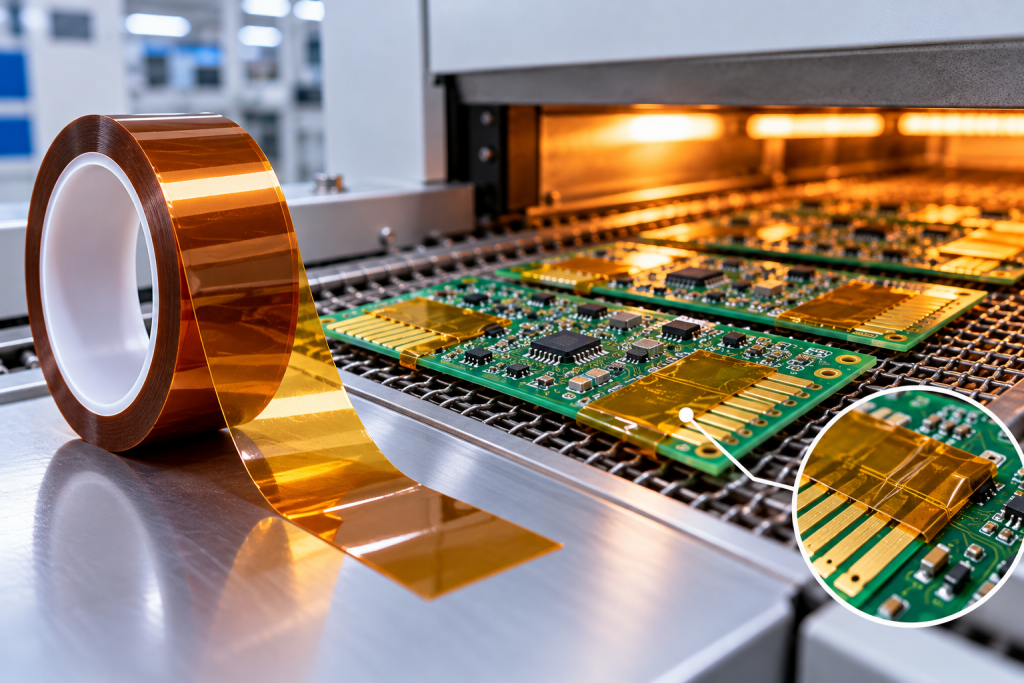
2. Why Polyimide Tape Is Used in PCB Reflow Soldering
A typical lead-free reflow soldering process may reach peak board temperatures of approximately 235–250°C, depending on the solder paste, component limitations, and validated temperature profile.
The tape must withstand the actual thermal exposure, not merely a temperature value printed on its technical data sheet.
Polyimide film provides a useful combination of thermal resistance, mechanical strength, and dimensional stability. When paired with an appropriate high temperature adhesive system, it can provide reliable temporary protection throughout the reflow cycle.
Thermal Stability During Reflow
One of the main concerns in high temperature masking is edge lifting.
If the tape begins to curl during heating, solder paste, flux, or other process contaminants may reach the area underneath.
Polyimide film maintains its structural integrity at temperatures commonly encountered in SMT reflow processes. However, the tape’s actual performance depends on the adhesive formulation, dwell time, surface condition, and complete temperature profile.
For this reason, the tape should be evaluated under the customer’s production conditions rather than selected by maximum temperature rating alone.
Clean Removal After Processing
Adhesive residue can be especially problematic on exposed electrical contacts and other sensitive PCB surfaces.
Residue may require additional cleaning and, in some cases, affect subsequent electrical contact or assembly operations.
A suitable high temperature masking tape should provide enough adhesion to remain in place during processing while allowing controlled removal afterward.
The goal is straightforward: protect the required area, complete the process, and remove the tape without introducing another manufacturing problem.
Dimensional Stability and Precision Masking
Modern PCB layouts often leave very little room for masking errors.
A tape that stretches during application or shrinks significantly during heating may expose areas that were intended to remain protected.
Polyimide tape is particularly useful in these situations because its film backing provides good dimensional stability.
For repetitive production, precision die-cut tape shapes can also help improve placement consistency and reduce operator handling time.
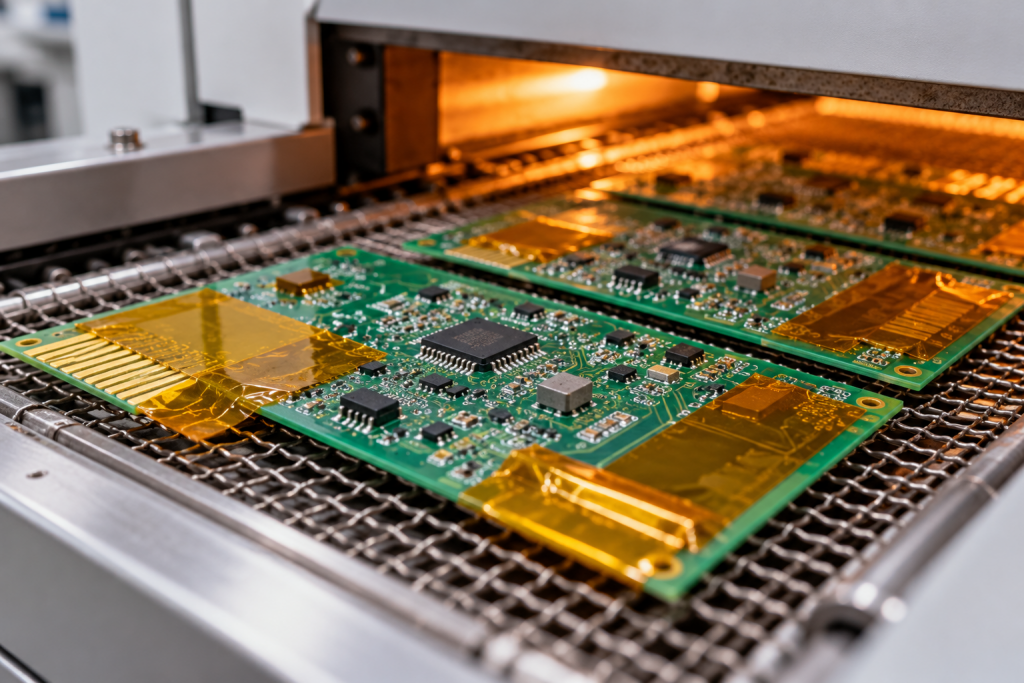
3. Application Process: From Masking to Tape Removal
The following workflow illustrates how high temperature tape can be integrated into a typical PCB reflow soldering operation.
Step 1 — Identify the protection areas
Before assembly, the process engineer identifies the surfaces that require masking. These areas are defined according to the PCB design, soldering process, and customer requirements.
Step 2 — Apply high temperature masking tape
The tape is applied to a clean, dry PCB surface with even pressure. Operators check for wrinkles, trapped air, and lifted edges. Tape placement must not interfere with solder paste printing, component placement, or solder joint formation.
Step 3 — Run the validated reflow profile
The PCB passes through the reflow oven according to the approved thermal profile. The masking tape must maintain its position throughout preheating, soaking, peak reflow, and cooling.
Step 4 — Remove the tape after cooling
Once the PCB has cooled to the specified handling temperature, the tape is removed at a controlled angle and speed. Excessive pulling force should be avoided, particularly around delicate components and surface finishes.
Step 5 — Inspect the protected surface
The operator checks the masking area for adhesive residue, discoloration, contamination, or surface damage. Any issues are recorded and evaluated before the tape is approved for regular production.
4. What Manufacturers Should Evaluate Before Selecting a Tape
Not every high temperature tape is suitable for every PCB process.
Two tapes may use similar polyimide backings but behave differently during reflow because of differences in adhesive chemistry, coating thickness, and manufacturing conditions.
The following factors deserve particular attention:
| Evaluation Item | Practical Consideration |
|---|---|
| Temperature resistance | Must withstand the validated peak temperature and dwell time |
| Adhesion | Sufficient to prevent edge lifting during processing |
| Residue performance | Check for adhesive transfer after actual reflow exposure |
| Dimensional stability | Minimal deformation during thermal cycling |
| PCB compatibility | Verify performance on the specific surface finish |
| Thickness and dimensions | Appropriate for masking accuracy and equipment clearance |
| Removal behavior | Controlled peeling without surface damage |
One important distinction is the difference between short-term temperature resistance and continuous service temperature.
A tape that survives a brief exposure to 260°C may not be suitable for prolonged exposure at the same temperature. Multiple reflow cycles can also produce different results from a single cycle.
For applications involving exposed contacts or highly sensitive surfaces, residue inspection and compatibility testing should be part of the qualification process.
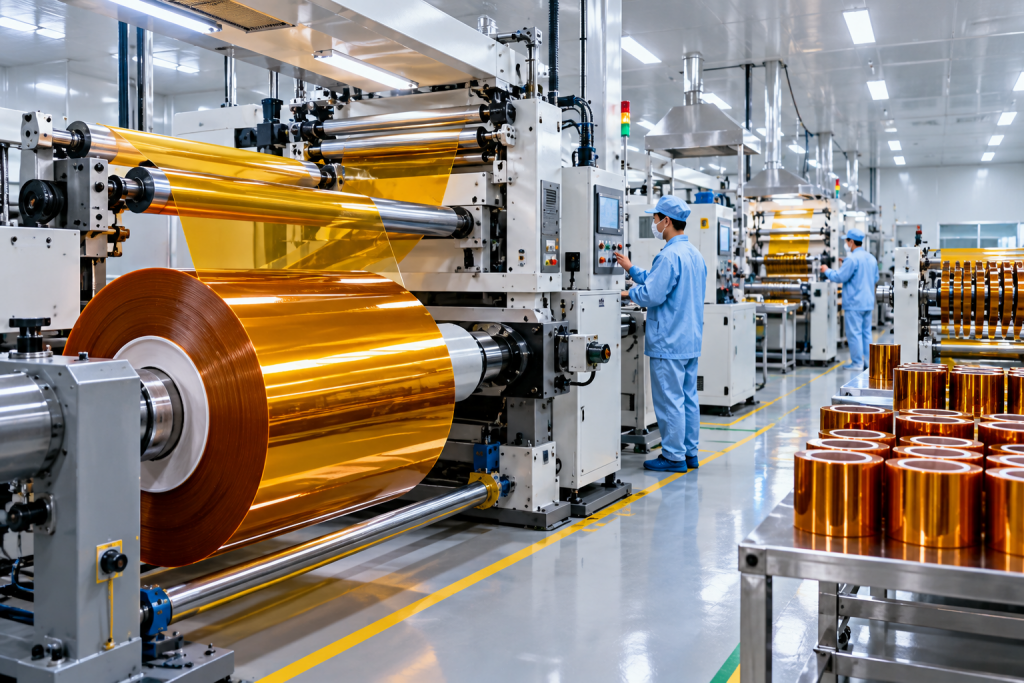
5. Engineering Solution: KHJ Polyimide High Temperature Tape
At KHJ, high temperature adhesive tapes are developed and supplied for electronics manufacturing applications where process consistency matters.
For PCB reflow protection, KHJ can work with manufacturers to select appropriate polyimide tape constructions based on the required temperature profile, adhesion characteristics, masking dimensions, and removal conditions.
Available solution options may include:
- Polyimide film tapes with silicone or acrylic adhesive systems, selected according to application requirements.
- Customized tape widths and roll lengths for different production environments.
- Precision die-cut masking shapes for defined PCB protection areas.
- Application-specific evaluation of thermal performance, adhesion, and residue behavior.
- Sample materials for qualification on actual SMT production lines.
For production engineers, the right tape is not necessarily the one with the highest advertised temperature rating. It is the one that performs consistently under the specific process conditions.
This is particularly important for high-volume SMT operations, where small variations in masking quality can create repeated rework across thousands of boards.
6. Expected Benefits in PCB Manufacturing
When the tape is properly selected and qualified, manufacturers can expect several practical improvements.
More consistent masking protection. Stable adhesion helps maintain coverage of designated areas throughout the soldering process.
Reduced cleaning and rework. Clean-removal performance can reduce the need for additional cleaning of protected surfaces.
Improved production consistency. Standardized tape dimensions and die-cut shapes can make masking operations more repeatable.
Better protection of sensitive PCB areas. Proper masking helps prevent unwanted process contamination of designated contacts and surfaces.
Easier process integration. Tape supplied in suitable roll formats or pre-cut shapes can be integrated into existing production workflows.
These benefits should be confirmed through line trials. Actual results depend on PCB surface finishes, temperature profiles, masking design, and operator procedures.
7. Conclusion
High temperature tape may appear to be a small consumable in the PCB assembly process, but its performance can directly influence masking quality, cleaning requirements, and production consistency.
For SMT manufacturers, selecting the right polyimide masking tape involves more than checking its heat resistance. Adhesive stability, surface compatibility, residue performance, and removal behavior all need to be considered.
A properly qualified tape can protect critical PCB areas during reflow soldering while keeping the subsequent manufacturing process clean and efficient.
KHJ supports electronics manufacturers with high temperature tape solutions, customized dimensions, and sample evaluation for different PCB assembly requirements.
Looking for a reliable high temperature tape for PCB reflow soldering?
Contact KHJ to discuss your PCB masking requirements, reflow temperature profile, and customized tape specifications.
Website: www.khjtech.com
TRENDING POSTS
- * Foam Tape in Smartphone Manufacturing: An Application Case for Bonding, Cushioning, and Sealing
- * SMT Splice Tape in PCB Assembly: A Practical Case for Continuous Component Feeding
- * UV Dicing Tape in Semiconductor Wafer Cutting: Reliable Wafer Holding and Clean Die Release
- * Thermal Release Tape for Sapphire Wafer Dicing: Secure Holding, Controlled Release and Cleaner Processing
- * Polyimide Tape in QFN Semiconductor Packaging: An Application Case from the Production Floor
HOT TOPIC
-
772
Acrylic Foam Tape
conductive cloth die cutting
Die-Cut
die cutting tape
Double Sided Foam Tape
EMI shielding gasket
foam die cutting
Foam Tape
graphite die cutting
heat restrant tape
heat sink die cutting
high temperature tape
kapton tape
khj
Labels
LCD buffer pad
LCD shielding
L foam
Non-silicone Polyimide Tape
PCB
PI tape
polyimide tape
polyimide tape,kapton tape
precision die cutting
Reflow soldering masking
SEMICON West
senmiconductor
tape
thermal management
thermal release tape
UV Release Tape
wafer
Wafer cutting